Flutter is a popular choice for building Android and iOS applications from a shared codebase. It can reduce duplicated development effort, but the final budget depends on product scope, design, backend systems, integrations, testing, security and ongoing support.
In 2026, AI-assisted development tools can help teams move faster on selected tasks. They do not remove the need for product decisions, architecture, code review, security testing or release management. This guide explains typical budget ranges, the factors that influence cost, and how to plan an MVP without compromising quality.
If you are evaluating a project, explore SerenialTech’s Flutter and mobile app development services for information about its app development capabilities.
1. How Much Does Flutter App Development Cost in 2026?
The ranges below are broad planning estimates for projects built by a professional development team. They are not fixed quotes. Actual pricing can vary significantly by country, team seniority, requirements, integrations and delivery model.
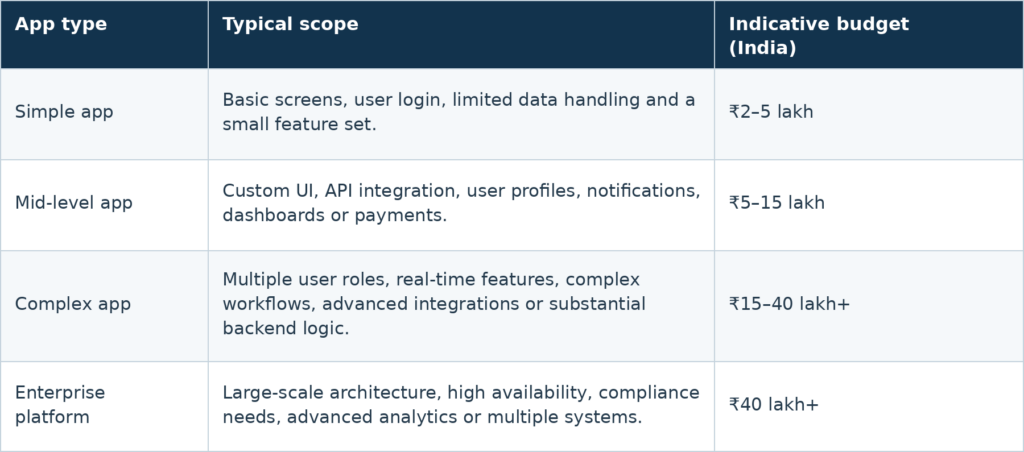
These figures are starting points, not market guarantees. A reliable estimate should be based on a feature list, user journeys, integrations, non-functional requirements and acceptance criteria.
2. What Determines Flutter App Development Cost?
Features and product complexity
The number of screens is only one part of the cost. A simple information app is very different from an app with subscriptions, payments, role-based access, offline operation, real-time updates or complex business rules. Define the core user journeys and prioritise features before requesting estimates.
UI/UX design
Custom visual design, prototyping, accessibility, responsive layouts and usability testing require time. Reusing a design system can improve consistency and reduce repeated design work, while still allowing important screens to receive focused attention.
Backend, APIs and cloud services
Authentication, databases, admin dashboards, notifications, file storage, analytics and third-party APIs can add significant effort. If the app connects to an existing platform, confirm API quality, documentation, rate limits and ownership early. SerenialTech’s app development team works across mobile applications and supporting software components.
Integrations and connected hardware
Payments, maps, CRM systems, Bluetooth Low Energy (BLE), Wi-Fi provisioning and IoT devices often need specialist implementation and testing. Hardware-connected apps may also require testing across device models, firmware versions and mobile operating systems. For products that combine software and physical devices, see SerenialTech’s industrial and mechanical design capabilities.
Security, testing and release
Budget for code review, automated and manual testing, accessibility, performance, security checks, app-store preparation and post-release monitoring. Apps that process sensitive data or support business-critical workflows may need additional threat modelling, audit trails and compliance work.
Maintenance and support
After launch, operating systems change, dependencies need updates, cloud usage grows and users request improvements. Plan for bug fixes, security updates, compatibility testing, monitoring and ongoing feature development rather than treating launch as the end of the project.
3. Fixed Price vs. Time and Materials
Fixed-price project
A fixed-price model can work when requirements, deliverables, assumptions and acceptance criteria are well defined. It offers a clearer budget, but changes outside the agreed scope may require change requests and additional fees.
Time and materials
With time and materials, you pay for the actual work completed at agreed rates. This model can suit evolving products, discovery work and MVPs where feedback is expected to change priorities. It requires active backlog management, regular demonstrations and transparent reporting.
Practical tip: If the product is still being validated, consider a short discovery phase followed by prioritised development sprints. Agree on a budget ceiling or review points so scope and spend remain visible.
4. How AI Is Affecting Flutter Development Costs in 2026
AI-assisted coding tools can help developers draft boilerplate, explain unfamiliar code, generate test cases, suggest refactors and speed up documentation. Used carefully, these tools can shorten some tasks and help teams explore implementation options faster.
AI does not automatically make a project cheaper by a fixed percentage. Results depend on the team, codebase, requirements, tool choice and how much review is needed. AI-generated code still needs validation for correctness, performance, maintainability, privacy and security.
Where AI can help
- Scaffolding routine code and common UI patterns.
- Drafting unit tests and identifying edge cases for human review.
- Explaining errors, proposing debugging steps and supporting refactoring.
- Creating technical documentation and summarising code changes.
Where expert oversight remains essential
- Architecture, data modelling and integration design.
- Security-sensitive logic, authentication, authorisation and payment flows.
- Device-specific testing, BLE behaviour, background execution and release readiness.
- Reviewing AI-generated output for hidden defects, licensing or privacy concerns.
The best approach is to measure delivery outcomes rather than assume AI guarantees savings. Ask vendors how AI fits into their workflow, what code-review standards they follow and how they test the finished product.
5. Hidden Costs to Include in Your Budget
- Cloud hosting and databases: Costs can increase with active users, storage, bandwidth and processing.
- Third-party services: SMS, email, maps, payment gateways, analytics and external APIs may have recurring fees.
- Developer accounts and store fees: Google Play and Apple developer programmes have their own account and policy requirements; confirm current fees directly with each platform.
- Maintenance: Operating-system updates, dependency upgrades, bug fixes and security patches.
- AI tools and AI features: Coding assistant subscriptions may be recurring; AI features inside the app can incur model/API usage charges.
- QA devices and services: Physical devices, test environments, monitoring and automated testing infrastructure.
- Content and compliance: Privacy notices, terms, localisation, accessibility and industry-specific obligations.
Ask for a proposal that separates one-time development costs from recurring operating costs. Clarify which subscriptions and third-party accounts will be owned and paid for by your business.
6. How to Reduce Cost with an MVP
A minimum viable product (MVP) should test the most important assumption with the smallest useful feature set. It is not simply a low-quality version of the final product.
- Define one primary user group and the problem the app must solve.
- List essential user journeys and separate must-have features from later enhancements.
- Use proven libraries and existing services where they meet the requirements.
- Build a clickable prototype to validate the experience before implementing every screen.
- Set measurable launch goals, such as activation, task completion or repeat usage.
- Plan the architecture so likely next steps can be added without rebuilding everything.
SerenialTech can help assess a product idea, define an MVP scope and plan the mobile and backend work. Learn more about mobile app development at SereialTech.
7. How to Compare Flutter App Development Companies
- Request a feature-based estimate with assumptions and exclusions.
- Ask who will handle UI/UX, Flutter development, backend, QA, security and deployment.
- Review relevant portfolio examples, particularly apps with similar integrations or device requirements.
- Confirm code ownership, repository access, documentation and handover arrangements.
- Ask how the team manages change requests, testing, release approvals and ongoing support.
- Discuss communication cadence, project reporting and how AI-assisted work is reviewed.
A clear scope and transparent delivery process are often more valuable than choosing the lowest headline quote. If you are ready to discuss a project, use the SerenialTech contact page to share your requirements.
8. Frequently Asked Questions
Is Flutter cheaper than native app development?
Flutter can reduce duplicated work when targeting Android and iOS from one codebase. It is not automatically cheaper in every case: platform-specific features, complex integrations, performance needs and team experience can affect the total cost.
Can AI reduce Flutter app development cost?
AI tools can speed up selected coding, testing and documentation tasks, but the overall impact varies. Requirements, architecture, review, security and device testing still need experienced oversight.
How long does it take to build a Flutter app?
A simple app may take weeks, while a feature-rich or enterprise product can take several months or longer. Timing depends on scope, integrations, team size, approvals and testing requirements.
What should a Flutter app development quote include?
It should explain scope, deliverables, milestones, assumptions, exclusions, third-party costs, testing, deployment, ownership, warranty or support terms, and how changes are priced.
What is the best way to get an accurate estimate?
Prepare a short product brief with target users, core features, platforms, integrations, design references, security needs and launch expectations. A discovery session can then clarify unknowns before a detailed estimate is prepared.
Planning Your Next Mobile App?
Whether you’re building a new Flutter application, developing an MVP, or integrating mobile software with connected hardware, SerenialTech can help you turn your idea into a practical product.
Our services include cross-platform mobile applications, IoT app development, UI/UX design, backend integration and ongoing technical support. Explore SerenialTech’s Flutter and mobile app development services to learn more.
Ready to discuss your requirements? Contact SerenialTech to discuss your application idea and request a project estimate.
Editorial note: The cost ranges in this article are indicative planning estimates, not a binding quotation. Validate the scope and current third-party platform fees before making budget decisions.
